
Diagnostic and Statistical Manual of Mental Disorders Fifth Edition (DSM-5)
What Is the DSM-5? The Diagnostic and Statistical Manual of Mental Disorders, Fifth Edition (DSM-5) is the main guide that mental...
What Is the DSM-5?
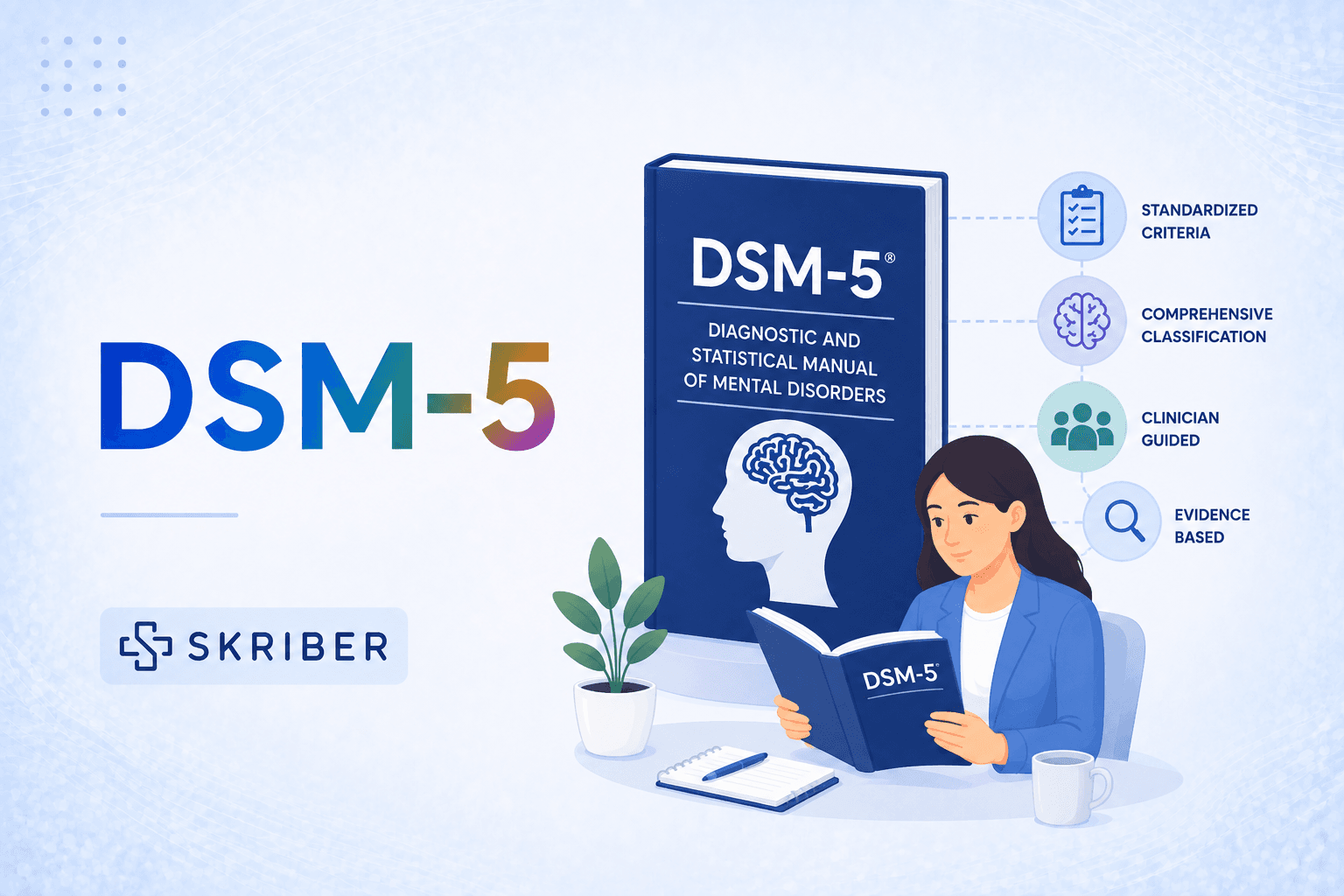
The Diagnostic and Statistical Manual of Mental Disorders, Fifth Edition (DSM-5) is the main guide that mental health professionals use to diagnose mental disorders. The American Psychiatric Association (APA) published it in 2013. This was the first big update since the DSM-IV came out in 1994. It took more than 10 years and hundreds of experts from around the world to create.
In March 2022, the APA released a text revision called DSM-5-TR. This update included new information based on the latest science. More than 200 experts worked on it. The DSM-5-TR added a new diagnosis called prolonged grief disorder. It also made clarifying changes to the criteria for more than 70 disorders. The DSM-5 is not just for psychiatrists. Psychologists, counselors, social workers, nurses, and other health professionals all use it. It gives everyone a common language to talk about mental disorders. This helps with diagnosis, treatment, and research.
The Structure of the DSM-5
Three Main Sections
The DSM-5 has three major parts. Section I is the introduction. It explains how to use the manual. Section II lists all the diagnostic criteria for mental disorders. These are organized into 20 categories. Section III includes emerging measures and models. This part has tools for assessment and conditions that need more research.
The Diagnostic Classification
The diagnostic classification is the official list of mental disorders that the DSM-5 recognizes. Each disorder has a diagnostic code. These codes come from the ICD-10-CM, which is the coding system used by all U.S. health professionals. Professionals use these codes for billing and data collection.
The Diagnostic Criteria Sets
For each disorder, the DSM-5 gives a set of diagnostic criteria. These criteria tell you what symptoms must be present and for how long. They also list other conditions that must be ruled out first. These criteria help make diagnosis more reliable. This means two different doctors are more likely to give the same diagnosis when they use the DSM-5.
Important: The criteria are meant to be used by trained professionals with clinical judgment. They are not meant for the general public to use on their own.
The Descriptive Text
The third part of the DSM-5 is the descriptive text that goes with each disorder. The DSM-5-TR text gives updated information about each disorder. It covers things like:
- Recording procedures
- Diagnostic features
- Prevalence (how common the disorder is)
- Development and course
- Risk and prognostic factors
- Culture-related diagnostic issues
- Gender-related diagnostic issues
- Suicide risk
- Functional consequences
- Differential diagnosis
- Comorbidity
Major Changes from DSM-IV to DSM-5
Elimination of the Multiaxial System
This is one of the biggest changes from DSM-IV. The DSM-IV used a five-axis system to organize information:
- Axis I: Mental health and substance use disorders
- Axis II: Personality disorders and intellectual disability
- Axis III: General medical conditions
- Axis IV: Psychosocial and environmental problems (like housing or employment)
- Axis V: Global Assessment of Functioning (GAF) score
The DSM-5 removed all of this. The GAF score was dropped because it was not clear enough in what it measured.
Some clinicians were concerned that removing this structure would make it harder to gather and organize clinical information. However, the change streamlined the evaluation process.
Reorganization of Disorders
The DSM-5 reorganized how disorders are grouped together. The DSM-IV had 17 chapters. The DSM-5 has 20. Six classes were added and four were removed. Many individual disorders were moved from one class to another. For example, some disorders that were under “mood disorders” were moved to “bipolar and related disorders”.
The new organization reflects a better understanding of how disorders are related. It was influenced by advances in neuroscience, clinical needs, and public health needs.
A Lifespan Perspective
The DSM-5 takes a lifespan perspective. This means it recognizes that age and development matter. They affect when a disorder starts, how it shows up, and how it should be treated.
New Disorders in DSM-5
Prolonged Grief Disorder
This was added in the DSM-5-TR (2022). It is for people who have severe grief that continues for a long time after someone close to them dies. The criteria require that:
- Someone close to the patient died
- At least 12 months have passed since the death
- The person has intense longing for the deceased or is preoccupied with thoughts of them
- The grief causes significant problems in daily life
Disruptive Mood Dysregulation Disorder (DMDD)
This was added to address severe temper outbursts in children. It was included to prevent children from being wrongly diagnosed with bipolar disorder.
Hoarding Disorder
This was added as a new disorder. It involves persistent difficulty getting rid of possessions, regardless of their actual value.
Excoriation (Skin Picking) Disorder
This was also added as a new disorder.
Binge Eating Disorder
This was moved from the appendix (where it was listed as needing more study) into the main manual.
Major Changes to Specific Disorders
Autism Spectrum Disorder (ASD)
The DSM-5 made big changes to how autism is diagnosed. It combined four separate conditions into one umbrella diagnosis called Autism Spectrum Disorder. These conditions were:
- Autistic Disorder
- Asperger’s Syndrome
- Pervasive Developmental Disorder Not Otherwise Specified (PDD-NOS)
- Childhood Disintegrative Disorder
The symptoms were also rearranged. The DSM-IV had three areas of symptoms. The DSM-5 has two:
- Social communication and interaction
- Restricted and repetitive behaviors
The DSM-5-TR made a small clarification to the wording. It changed “as manifested by the following” to “as manifested by all of the following”. This made it clear that all three social communication deficits must be present.
Substance Use Disorders
The DSM-5 made major changes to how substance problems are diagnosed. The DSM-IV had two separate categories:
- Substance abuse
- Substance dependence
The DSM-5 combined these into one category called Substance Use Disorder. This single disorder has levels ranging from mild to severe.
The DSM-5 also added “craving” as a new diagnostic criterion. It removed the criterion about recurrent legal problems because it was not helpful for diagnosis. The total number of criteria went from 7 to 11. A person needs 2 out of 11 criteria in a 12-month period to be diagnosed.
Posttraumatic Stress Disorder (PTSD)
PTSD was moved to a new chapter called “Trauma- and Stressor-Related Disorders”. The definition of a traumatic event was clarified. The criteria were also reorganized.
Depression and Bereavement
The DSM-IV had a rule that said you could not diagnose major depression within the first two months after a loved one died. This was called the “bereavement exclusion.” The DSM-5 removed this rule. This was controversial. Some people felt it would lead to over-diagnosis of depression in grieving people.
Neurocognitive Disorders
This area saw major revision and expansion. The DSM-5 introduced:
- Major Neurocognitive Disorder
- Mild Neurocognitive Disorder
This replaced the older term “dementia.” The change recognizes that cognitive problems can range from mild to severe.
Personality Disorders
The DSM-5 made important changes to personality disorders. In the main part of the manual (Section II), it kept 10 personality disorder types. However, in Section III, it introduced a new “alternative model” for personality disorders.
This alternative model is a hybrid approach. It keeps six personality disorder types:
- Borderline Personality Disorder
- Obsessive-Compulsive Personality Disorder
- Antisocial Personality Disorder
- Avoidant Personality Disorder
- Narcissistic Personality Disorder
- Schizotypal Personality Disorder
The DSM-5 also ended the separation between Axis II (personality disorders) and Axis I (other disorders).
Elimination of the Multiaxial System (Revisited)
This change also affected personality disorders. In the DSM-IV, personality disorders were coded on Axis II. With the removal of the multiaxial system, personality disorders are now coded like any other disorder.
The DSM-5-TR (2022 Update)
What Is the DSM-5-TR?
The DSM-5-TR stands for “Diagnostic and Statistical Manual of Mental Disorders, Fifth Edition, Text Revision”. It was published in March 2022. This was the first revision since the DSM-5 came out in 2013.
The DSM-5-TR includes fully revised text and references. It also has updated diagnostic criteria and ICD-10-CM insurance codes.
New Diagnoses in DSM-5-TR
The DSM-5-TR added several new diagnostic entities:
- Prolonged Grief Disorder (as discussed above)
- Unspecified Mood Disorder
- Stimulant-Induced Mild Neurocognitive Disorder
It also added codes for:
- “No diagnosis or condition”
- Suicidal behavior
- Nonsuicidal self-injury
Changes to Criteria
The DSM-5-TR made modifications and clarifications to the criteria for more than 70 disorders. Most of these changes were for clarifying ambiguous wording and fixing inconsistencies.
Updated Terminology
Several disorders were renamed. For example:
- Social anxiety disorder (new name)
- Persistent depressive disorder (new name)
The DSM-5-TR also updated terms related to gender. For example:
- “Natal male” became “assigned male at birth”
- “Natal female” became “assigned female at birth”
- “Cross-sex medical procedure” became “gender-affirming medical procedure”
Focus on Racism and Discrimination
The DSM-5-TR included a comprehensive review of how racism and discrimination affect the diagnosis and presentation of mental disorders. An Ethnoracial Equity and Inclusion Work Group reviewed the entire text. They made sure there was appropriate attention to risk factors like racism and discrimination. They also worked to use non-stigmatizing language.
More than 200 experts worked on the DSM-5-TR. The manual continues to be updated through an online process. Researchers can submit proposals for changes.
How Professionals Use the DSM-5
In Clinical Practice
Mental health professionals use the DSM-5 every day in their work. They use it to:
- Assess patients’ symptoms
- Make accurate diagnoses
- Develop treatment plans
- Communicate with other professionals
- Bill insurance companies
The DSM-5 is used in many settings. These include inpatient hospitals, outpatient clinics, private practice, and primary care.
For Research
Researchers use the DSM-5 to:
- Define who has which disorder in studies
- Compare results across different studies
- Test new treatments
For Education
The DSM-5 is used to train new mental health professionals. Students in psychology, social work, counseling, and psychiatry all learn to use it.
Who Uses the DSM-5?
Many different professionals use the DSM-5:
- Psychiatrists
- Psychologists
- Counselors
- Social workers
- Nurses
- Occupational therapists
- Rehabilitation therapists
- Forensic specialists
- Legal specialists
Important Limits
The DSM-5 criteria are meant to be used by trained professionals. Clinical judgment is still very important. The manual is a tool, not a replacement for good clinical thinking.
Controversies and Criticisms
Validity Concerns
Many critics have said that the science behind the DSM-5 is not as strong as the manual’s confident language suggests. Some critics argue that the DSM system has a serious validity problem. This means it is not clear whether the diagnoses in the manual represent real, distinct conditions.
The Categorical Approach
The DSM-5 uses a categorical approach. This means it puts disorders into separate boxes. Critics say this does not match reality. In real life, mental health problems often exist on a spectrum. People may have symptoms that do not fit neatly into one category.
Comorbidity Issues
Many people have more than one disorder at the same time. This is called comorbidity. Critics say the DSM-5 does not handle this well. The categories overlap too much.
Over-Pathologizing
Some critics worry that the DSM-5 makes too many normal experiences into mental disorders. For example, removing the bereavement exclusion for depression was controversial. Some felt it would turn normal grief into a mental illness.
Lack of Biomarkers
Another criticism is that the DSM-5 does not include enough neurobiological discoveries and biomarkers. Unlike many physical health conditions, mental disorders in the DSM-5 are diagnosed based on symptoms alone. There are no blood tests or brain scans for most disorders.
Elimination of the Multiaxial System
Some clinicians were concerned that removing the multiaxial system would make it harder to gather important contextual information about patients. The system had provided a structured way to think about all aspects of a person’s life.
Scientific Rhetoric vs. Science
Critics have pointed out that the DSM-5’s authors sometimes sound more confident than the science actually supports. However, some have noted that the DSM-5 did provide a more honest acknowledgment of the manual’s limitations compared to earlier editions.
The Future of the DSM
Ongoing Updates: The DSM-5-TR is not the end of the road. The APA continues to update the manual through an online process. Researchers and clinicians can submit proposals for changes. Each proposal goes through an extensive review process. Recent updates include changes to ICD-10-CM codes that went into effect in October 2025.
Proposed Changes: As of 2026, there is a proposal to clarify Criterion A and Criterion B severity specifiers for Autism Spectrum Disorder. Public comment on this proposal is open until April 30, 2026.
The Goal: The overriding goal of the DSM is to maintain its usefulness as the prime diagnostic reference for psychiatry. As the field advances, the DSM will continue to be updated. This provides clinicians and researchers with the most accurate information.
DSM and ICD Alignment: The DSM-5 was developed with an eye toward better alignment with the International Classification of Diseases (ICD). The ICD is the World Health Organization’s system. The goal is to bring psychiatry closer to a single, cohesive classification system.
Key Takeaways for Professionals
The DSM-5 is the standard. It provides the common language that all mental health professionals use to talk about mental disorders.
The DSM-5-TR is the current version. It was published in 2022 and includes important updates.
Use clinical judgment. The criteria are tools to guide your thinking. They do not replace your professional judgment.
Stay updated. The DSM continues to change. Check regularly for updates to criteria, text, and codes.
Consider the whole person. Think about cultural context, gender, age, and social factors. The DSM-5-TR pays more attention to these issues than previous editions.
Be aware of limitations. The DSM-5 is not perfect. It has valid criticisms. Use it thoughtfully.
Document carefully. Use the proper diagnostic codes for billing and record-keeping.
Conclusion
The DSM-5 and its text revision, the DSM-5-TR, are essential tools for mental health professionals. They provide a standardized way to diagnose mental disorders. This helps with treatment, research, and communication among professionals. DSM-5 made many important changes from the DSM-IV. These include eliminating the multiaxial system, reorganizing disorders, adding new disorders, and changing criteria for many existing disorders. The DSM-5-TR added prolonged grief disorder and made clarifying changes to more than 70 disorders. The manual has its critics. Some question the validity of its categories. Others worry about over-diagnosis. But despite these criticisms, the DSM-5 remains the most important diagnostic tool in mental health.
As a professional, your job is to use the DSM-5 wisely. Use your clinical judgment. Consider each person as a whole. Stay informed about updates. And always remember that the DSM-5 is a tool to help people, not an end in itself. The field of mental health continues to progress. New research will lead to new understandings. The DSM will continue to change with it. Your commitment to learning and growth will help you provide the best care possible to those who need it.