
What Is a Superbill?
What Exactly Is a Superbill? A superbill is a detailed, itemized document that healthcare providers give to patients after a...
What Exactly Is a Superbill?
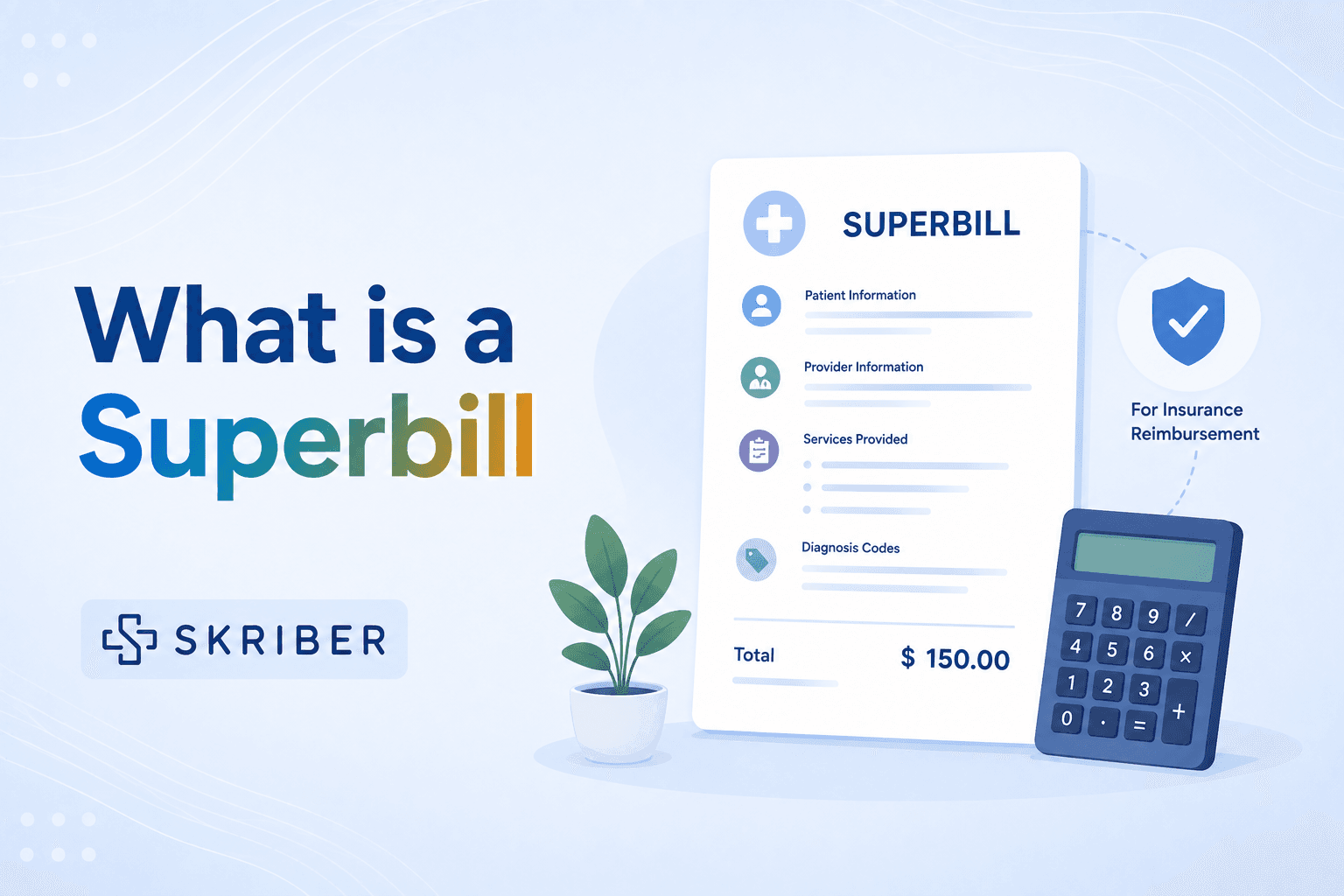
A superbill is a detailed, itemized document that healthcare providers give to patients after a medical visit. Think of it as a special receipt that goes far beyond a simple cash register receipt. While a regular receipt might just say “Office Visit – $150,” a superbill translates that visit into the specific language that insurance companies understand.
The superbill contains medical codes that describe what services were provided (CPT codes) and why they were medically necessary (ICD-10 diagnosis codes). It includes all the information an insurance company needs to process a reimbursement claim from a patient.
Here is the most important thing to understand: the superbill is not an insurance claim. The practice does not submit it to the insurance company. Instead, the practice gives it to the patient, and the patient submits it to their insurer to request reimbursement for out-of-pocket expenses.
Superbills go by many different names. You might hear them called encounter forms, charge slips, fee tickets, or insurance reimbursement statements. But no matter what you call them, they all serve the same basic purpose: they bridge the gap between the clinical care you provide and the financial reimbursement your patients seek from their insurance companies.
Why Superbills Matter: The Importance for Your Practice
Superbills are not just administrative paperwork. They are important tools that affect your practice’s revenue, your patients’ satisfaction, and the overall efficiency of your billing operations.
First, superbills protect your revenue cycle. The superbill is often the very first step in the billing process. It captures the charges for the services you provided. If the superbill is inaccurate or incomplete, the downstream effects can be costly. Missing codes or incorrect information can lead to claim denials, delayed payments, and lost revenue. Clean charge capture at the superbill stage leads to cleaner claims and faster reimbursement.
Second, superbills help your patients get their money back. When you see out-of-network patients or operate a cash-pay practice, your patients have already paid you directly. The superbill is their only way to recover some of that money from their insurance company. Without a properly prepared superbill, your patients cannot get reimbursed. This can lead to patient frustration and even cause them to leave your practice.
Third, superbills reduce administrative headaches. When your superbills are accurate and complete, your billing staff spends less time fixing errors and chasing down missing information. Patients call your front desk less often asking why their insurance denied their claim. Everyone benefits from a smoother process.
Fourth, superbills support patient autonomy and access to care. For many patients, especially those with out-of-network benefits, superbills make it possible to see the provider they want rather than being limited to in-network options. This is particularly important in behavioral health, where patients may struggle to find an in-network therapist who is accepting new patients.
Who Issues a Superbill?
The healthcare provider who delivers the service is the one who creates and issues the superbill. However, in many practices, the actual task of preparing the superbill falls to medical billing staff or a revenue cycle management team.
Here is how it typically works:
The provider documents the visit. During or immediately after the patient encounter, the provider records the diagnoses, the services performed, and any other relevant clinical details.
The billing team prepares the superbill. In many practices, the provider hands off this information to the billing department. The billing staff then translates the clinical information into the correct medical codes (CPT and ICD-10) and populates the superbill with all the required fields.
The practice gives the superbill to the patient. After the visit, the practice provides the completed superbill to the patient. This can happen in person, through a patient portal, or via email.
The patient submits it to their insurance. The patient then takes the superbill and submits it to their insurance company along with any required claim forms.
In some practices, the billing team may go one step further and submit the claim directly to the insurer on the patient’s behalf. This is sometimes called “concierge submission” and can be a nice value-add for patients.
It is worth noting that the superbill is not considered part of the official medical record. It is a communication tool between the provider, the billing department, and the patient. The actual medical record, the clinical notes you write, is what documents the medical necessity of the services provided.
The Components of a Complete Superbill
A superbill must contain specific information to be accepted by an insurance company. Missing even one required field can result in a denied claim. Here is a breakdown of everything a complete superbill should include.
Patient Information
This section must match exactly what appears on the patient’s insurance card. Include:
- The patient’s full legal name
- Date of birth
- Address
- Insurance member ID and group number
- Name of the insured person (if different from the patient)
Even a single digit wrong in a policy number can trigger an automatic claim rejection.
Provider Information
This section identifies who delivered the care. Include:
- The provider’s full legal name and credentials
- Practice name
- Practice address and phone number
- National Provider Identifier (NPI) number
- Tax Identification Number (EIN or SSN)
- Provider Taxonomy Code (a 10-digit specialty code required by many payers)
If a referring provider was involved, their information should also appear separately.
Date and Place of Service
The exact date(s) of the patient encounter must be clearly documented. You also need a Place of Service (POS) code. This is a standardized code that indicates where the care was delivered. For example:
- 11 = Office
- 02 = Telehealth
- 10 = Telehealth in the patient’s home
ICD-10 Diagnosis Codes
These codes describe the patient’s diagnosis or condition. They are maintained by the World Health Organization and required by CMS for all U.S. healthcare billing. ICD-10 codes must be as specific as possible. Using outdated ICD-9 codes will result in automatic claim rejection.
CPT or HCPCS Procedure Codes
CPT codes (Current Procedural Terminology) are published and maintained by the American Medical Association. They describe every medical service performed during the visit. HCPCS codes are used for services not covered by CPT codes, such as certain supplies or equipment.
Modifiers
Modifiers are two-digit codes added to a CPT code. They indicate that a procedure was altered in some way without changing its basic definition. For example, modifier 25 is used when a significant, separately identifiable evaluation and management service is performed on the same day as a procedure.
Fees Charged and Amount Paid
The superbill should clearly state the fee charged for each service. It should also show the amount the patient already paid. This establishes that the patient has paid out of pocket and is seeking reimbursement.
Provider Signature
Many insurers require the provider’s signature or an official stamp on the superbill. Some plans may also want the provider’s license number.
Superbill vs. CMS-1500: What Is the Difference?
This is one of the most common points of confusion in medical billing. The superbill and the CMS-1500 form serve different purposes and are used in different situations.
The CMS-1500 is the formal claim form that providers submit directly to insurance companies for in-network billing. When you are in-network with a patient’s insurance plan, your billing team typically submits a CMS-1500 form directly to the payer. The insurance company pays you directly for the services.
The superbill is a patient-facing document used for out-of-network billing. When you are out-of-network, the patient pays you directly. You give them a superbill. They submit it to their insurance company. The insurance company reimburses the patient directly.
Here is a simple way to remember the difference:
| Feature | Superbill | CMS-1500 |
|---|---|---|
| Purpose | Patient-led insurance reimbursement | Provider-led insurance billing |
| Who submits? | Patient | Provider or billing department |
| Used for | Out-of-network claims | In-network claims |
| Medical codes? | Yes | Yes |
| Insurance accepts? | Yes (for out-of-network) | Yes (for in-network) |
Both documents contain similar information, CPT codes, ICD-10 codes, provider identifiers, and patient information. But they are submitted by different parties and used in different billing scenarios.
Some practices choose to submit claims on behalf of their out-of-network patients using a CMS-1500 form rather than giving the patient a superbill. This is perfectly acceptable, but it requires the practice to take on the administrative work of claim submission.
How to Use a Superbill: Step-by-Step
Using a superbill effectively involves a clear workflow. Here is how the process typically works from start to finish.
Step 1: The Patient Visit
The provider sees the patient, performs an evaluation or treatment, and documents the encounter in the medical record.
Step 2: Create the Superbill
The provider or billing staff translates the clinical documentation into the appropriate medical codes and populates the superbill with all required information. Many practices use their EHR system to generate superbills automatically.
Step 3: Give the Superbill to the Patient
After the appointment, the practice provides the completed superbill to the patient. This can be done in person, through a secure patient portal, or by email.
Step 4: Patient Submits the Superbill
The patient takes the superbill and submits it to their insurance company. Most insurers have an online portal where patients can upload the superbill and complete a claim form. Some insurers still accept claims by mail or fax.
Step 5: Insurance Processes the Claim
The insurance company reviews the superbill, checking the procedure codes, diagnosis codes, and coverage status. If approved, the insurer sends reimbursement directly to the patient. This typically takes 2 to 4 weeks.
Step 6: Patient Receives Reimbursement
The patient receives an Explanation of Benefits (EOB) from their insurance company showing what was covered and what they will be reimbursed. The reimbursement amount depends entirely on the patient’s out-of-network benefits.
Insurance-Related Considerations
Understanding how insurance companies handle superbills is essential for both providers and patients. Here are some key things to know.
Out-of-Network Benefits Vary Widely
Not all insurance plans cover out-of-network services. Patients with PPO (Preferred Provider Organization) or POS (Point of Service) plans typically have out-of-network benefits. Patients with HMO (Health Maintenance Organization) plans often do not. Before seeing an out-of-network provider, patients should call their insurance company and ask about their out-of-network coverage.
Reimbursement Is Not Guaranteed
Even with out-of-network benefits, there is no guarantee of reimbursement. The insurance company will review the superbill and determine what, if anything, they will pay. Common reasons for denial include plan exclusions, inaccurate coding, and missing documentation.
Most Plans Have Filing Deadlines
Insurance companies typically require claims to be filed within a certain timeframe, usually 90 days to one year from the date of service. If the patient misses this deadline, they lose their chance for reimbursement.
Medicare and Medicaid Usually Do Not Accept Superbills
Services billed through superbills are rarely reimbursed under Medicare or Medicaid. These programs have specific submission protocols and generally do not accept patient-submitted claims.
Patients Should Check Their Deductible
Many out-of-network plans have high deductibles. Some patients may need to pay several thousand dollars out of pocket before their insurance covers anything. Patients should understand their deductible before deciding to see an out-of-network provider.
FSA and HSA Documentation
Superbills can also be used for Flexible Spending Account (FSA) and Health Savings Account (HSA) documentation. Even when a practice does bill insurance, some patients request superbills for FSA or HSA reimbursement.
Best Practices for Creating Superbills
Following these best practices will help you create accurate, effective superbills that serve your patients well and protect your practice.
Use Your EHR System: Generate superbills from your EHR or practice management software whenever possible. This auto-fills patient and provider information, reducing the risk of errors. Manual data entry is prone to mistakes.
Pre-Load Common Codes Every practice has a set of diagnoses and procedures they use frequently. Pre-load these codes into your superbill template. This saves time and reduces the chance of selecting the wrong code.
Be Specific with Diagnosis Codes: ICD-10 codes must be as specific as possible. Vague or general codes may not justify medical necessity and can lead to claim denial. Take the time to select the most precise code that matches the patient’s condition.
Include Modifiers When Needed:
Modifiers can make the difference between a paid claim and a denied claim. Make sure your billing staff understands when and how to use modifiers correctly.
Double-Check Provider Information: Ensure that the provider’s NPI, tax ID, and taxonomy code are correct and match what the payer has on file. Mismatched information is a common reason for claim denial.
Customize Templates for Different Payers: Different insurance companies may have different requirements. A one-size-fits-all template might not meet every payer’s standards. Consider customizing your superbill template for the insurers your patients most commonly use.
Train Your Staff: Make sure everyone involved in creating superbills understands what information is required and why. Regular training on coding updates and payer requirements can prevent costly errors.
Review for Completeness Before Giving to Patients: Before handing a superbill to a patient, review it for completeness. Missing any required field can lead to claim denial. A few extra seconds of review can save your patients weeks of frustration.
Common Errors to Avoid
Even small errors on a superbill can result in denied claims and frustrated patients. Here are the most common mistakes to watch out for.
Missing or Incomplete Provider Information
Forgetting to include the provider’s full name, NPI, or Tax ID is surprisingly common. Most insurance companies require this information to verify the provider. Without it, the claim may be denied before it is even reviewed.
Incorrect or Vague Diagnosis and Procedure Codes
Using incorrect, outdated, or vague codes is one of the most frequent errors. Insurance companies rely on these codes to understand what service was provided and why. If the codes do not match the documentation or are not sufficiently specific, the claim will be denied.
Missing Patient Information
Missing or incorrect patient details, such as a wrong date of birth or policy number, can trigger automatic denials. Always verify patient information against their insurance card.
Using Generic Templates
Generic templates downloaded from the internet may not meet all payer requirements. Different insurers have different documentation needs. A poorly matched template can lead to claim rejection.
Wrong Date of Service
A wrong date of service can cause the claim to bounce back before it even reaches the payer’s review system. Double-check all dates.
Missing Modifiers
Modifiers are not optional when they are needed. A missing modifier can result in a denied claim. Make sure your billing staff understands when modifiers are required.
Incomplete Fee Information
The superbill must clearly show both the fee charged and the amount the patient paid. If this information is missing or unclear, the insurance company may not process the claim.
When to Use a Superbill
Superbills are not appropriate for every situation. Here is when you should use them and when you should use other methods.
Use a Superbill When:
- You are an out-of-network provider
- You operate a cash-pay or direct-pay practice
- The patient has a PPO or POS plan with out-of-network benefits
- The patient requests documentation for FSA or HSA reimbursement
- You want to offer patients the option to seek reimbursement without taking on the administrative burden of claim submission
Do Not Use a Superbill When:
- You are in-network with the patient’s insurance plan (use CMS-1500 instead)
- The patient has Medicare or Medicaid (these programs typically do not accept patient-submitted claims)
- The patient has an HMO plan without out-of-network benefits
- You are willing and able to submit claims on behalf of your out-of-network patients (you can use CMS-1500 instead)
The No Surprises Act and Superbills
The No Surprises Act, which took effect in January 2022, has important implications for cash-pay practices that use superbills. Under the No Surprises Act, providers are required to give uninsured and self-pay patients a Good Faith Estimate (GFE) before the visit. The GFE must include expected charges for the visit. If the final bill exceeds the GFE by more than $400, the patient has grounds to dispute the charges. For cash-pay practices that issue superbills, this means you need both documents in your workflow: the GFE before the visit and the superbill after. The GFE sets expectations for the patient. The superbill documents what actually happened and what was charged.
Conclusion
The superbill is a simple but powerful tool that connects the clinical care you provide with the financial systems that support it. When done correctly, superbills help your patients get reimbursed, protect your practice’s revenue, and reduce administrative headaches for everyone involved. The key to success with superbills is accuracy and completeness. Every field matters. Every code counts. A missing modifier or a wrong date can turn a valid claim into a denied claim. Take the time to get it right, and your patients, and your billing staff, will thank you. Remember, the superbill is not just paperwork. It is the bridge between your clinical expertise and your patients’ financial well-being. Treat it with the care and attention it deserves.