
Z-Codes
What Are Z-Codes and Why Do They Matter? Z-codes are a special group of diagnosis codes found in the ICD-10-CM...
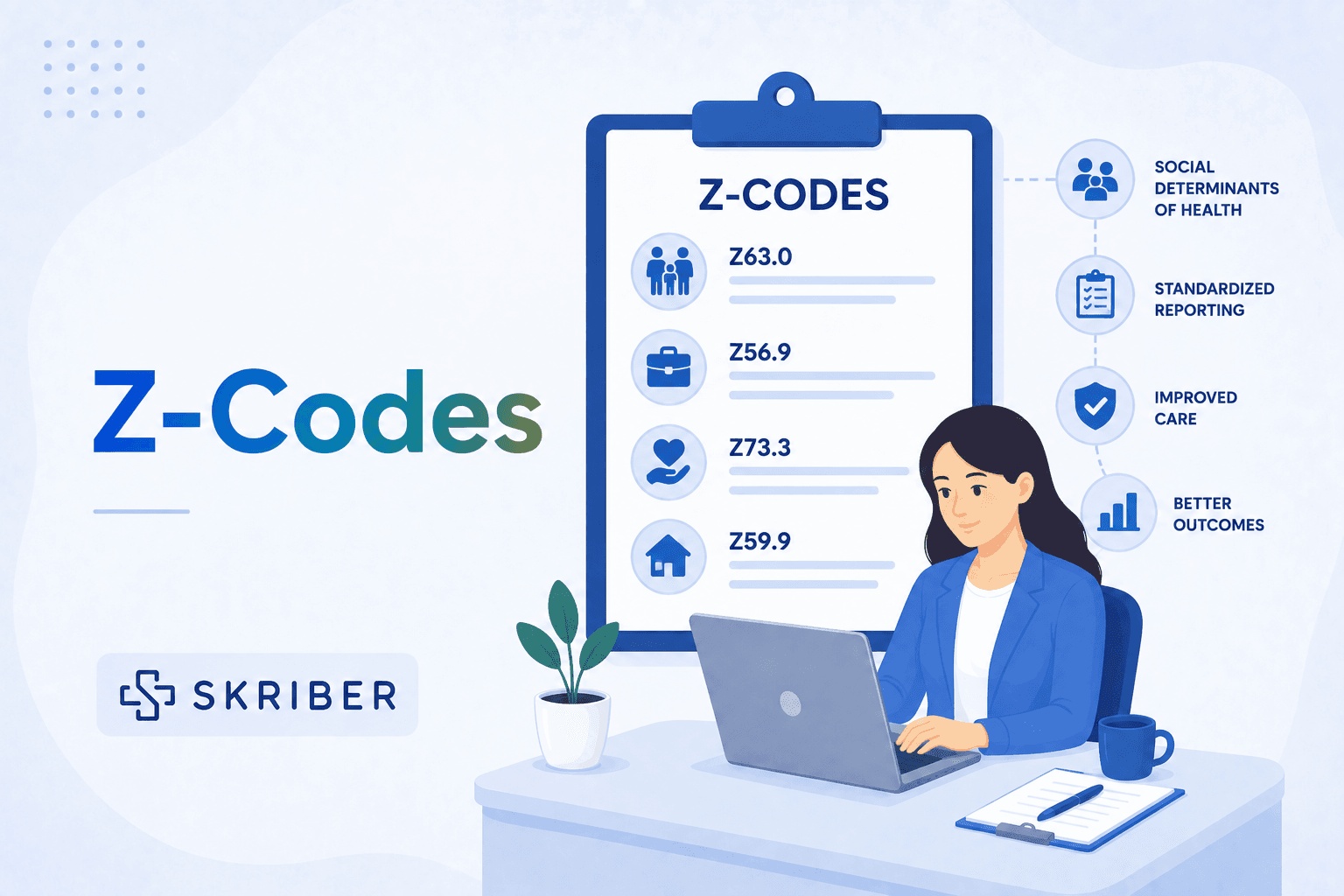
What Are Z-Codes and Why Do They Matter?
Z-codes are a special group of diagnosis codes found in the ICD-10-CM coding system. They live in Chapter 21, which is called “Factors influencing health status and contact with health services (Z00-Z99)”. Unlike regular diagnosis codes that describe diseases or injuries, Z-codes capture the other stuff that affects a patient’s health. They describe reasons why a person seeks care that are not actually sicknesses. Think of them as the “everything else” category that helps paint a full picture of what is going on with a patient.
For example, a patient might come in for a routine physical exam. That is not a disease. It is just a check-up. Or a patient might have trouble getting to appointments because they do not have a car. That is not a medical condition either. But both of these things matter for their health. Z-codes give us a way to write these things down in the medical record in a standardized way. This matters because what happens outside the doctor’s office often affects what happens inside it more than we think.
The move to Z-codes happened when healthcare switched from ICD-9 to ICD-10. Before this change, these types of codes were called “V-codes.” The new Z-codes give much more detail and cover more situations than the old V-codes ever did. They are not procedure codes either. They do not describe what the doctor did. They describe why the patient came in or what factors might affect their care.
The 16 Categories of Z-Codes
The ICD-10-CM code book breaks Z-codes down into 16 main categories. Each category covers a different type of situation. Here is a simple breakdown:
| Category Range | What It Covers |
|---|---|
| Z00-Z13 | Encounters for examinations (check-ups, screenings) |
| Z14-Z15 | Genetic carrier and genetic susceptibility |
| Z16 | Resistance to antimicrobial drugs |
| Z17 | Estrogen receptor status |
| Z18 | Retained foreign body fragments |
| Z19 | Hormone sensitivity malignancy status |
| Z20-Z29 | Persons with potential health hazards related to communicable diseases |
| Z30-Z39 | Encounters for reproductive health (pregnancy, contraception) |
| Z40-Z53 | Encounters for specific procedures and aftercare |
| Z55-Z65 | Social determinants of health (SDOH) |
| Z66 | Do not resuscitate status |
| Z67 | Blood type |
| Z68 | Body mass index (BMI) |
| Z69-Z76 | Persons encountering health services in other circumstances |
| Z77-Z99 | Persons with potential health hazards related to family and personal history |
Each of these categories contains many specific codes underneath them. For instance, Z55 covers problems with education and literacy. Z55.0 means illiteracy or low-level literacy. Z56 covers employment problems. Z56.0 means unemployment. The codes get very specific, which helps doctors and billers describe exactly what is going on.
The Z55-Z65 range is especially important right now. These codes cover social determinants of health (SDOH). SDOH are the conditions where people are born, live, learn, work, and play. Things like housing problems, food insecurity, trouble with transportation, and lack of money all fall into this range. Research shows that these social factors often affect health outcomes more than medical care itself does. So tracking them with Z-codes helps healthcare systems understand and address the root causes of poor health.
Z-Codes vs. V-Codes: What Changed?
If you have been in healthcare for a while, you remember V-codes. They were the old way of coding these same types of situations in ICD-9. When healthcare moved to ICD-10, V-codes went away and Z-codes took their place. This was not just a name change. The new system gives us much better tools.
V-codes in ICD-9 had five digits and were mostly numbers. Z-codes in ICD-10 have three to seven characters. The first character is always “Z” followed by numbers. This extra space allows for much more detail. For example, the old code for homelessness was V60.0. The new system breaks this down into Z59.0 (homelessness unspecified), Z59.01 (sheltered homelessness), and Z59.02 (unsheltered homelessness). That level of detail helps providers understand the exact situation their patient is facing.
Another big difference is how comprehensive Z-codes are. Compared to DSM-5 V-codes (which are used in mental health), ICD-10 Z-covers a much wider variety of psychosocial problems. Z-codes also provide clinical information that V-codes sometimes did not. For instance, therapy services used to just get a V-code that basically said “therapy is happening.” Now Z-codes can describe why therapy is needed and what factors are involved. This makes the medical record more useful for everyone who reads it.
Examples of Z-Codes in Action
Let us look at some real examples of how Z-codes work in practice. These cases come from actual clinical settings and show why these codes matter.
Case 1: Health Literacy Problems
A 60-year-old patient with cancer comes in for a post-surgery visit. The doctor recommends chemotherapy. But the counseling takes much longer than expected because the patient has trouble understanding medical information. The doctor adds Z55.6 (Problems related to health literacy) to the diagnosis list. This code explains why the visit took extra time. It also flags that this patient might need extra help understanding their care going forward.
Case 2: Transportation and Money Problems
A 45-year-old cancer patient misses half of their radiation appointments. When the doctor asks why, the patient explains their car broke down. They cannot afford to fix it. The bus is unreliable. They are worried about losing their job because of all the missed time. The doctor adds three Z-codes: Z59.82 (Transportation insecurity), Z59.6 (Low income), and Z56.2 (Threat of job loss). These codes tell the full story. The patient is not just missing appointments for no reason. There are real barriers. The care team can then help find transportation resources and provide work documentation.
Case 3: Food Insecurity and Family Problems
A 70-year-old cancer patient has lost weight since their last visit. They report decreased appetite, but they also share that their husband moved out three weeks ago. They had been fighting about their son, who struggles with drug abuse. The doctor adds Z59.4 (Lack of adequate food), Z63.0 (Problems in relationship with spouse or partner), and Z63.72 (Alcoholism or drug addiction in family). These codes capture the social and emotional factors affecting this patient’s health. The care team can then connect the patient with a dietitian and offer emotional support.
These examples show that Z-codes are not just bureaucratic paperwork. They tell the real story of what patients are dealing with. They help care teams understand the whole person, not just the disease.
Z-Codes and Insurance: What You Need to Know
For a long time, Z-codes did not affect how much money providers got paid. They were mostly used for tracking statistics. That has changed. Today, Z-codes play a growing role in insurance reimbursement, and providers who ignore them may leave money on the table.
The Centers for Medicare & Medicaid Services (CMS) now requires hospitals that take Medicare payments to screen all inpatients aged 18 and older for social determinants of health. These screenings use Z-codes from the Z55-Z65 range. Ambulatory providers (those who see patients in offices rather than hospitals) can also get extra Medicare incentives for capturing SDOH data. This means there is a financial upside to using these codes correctly.
Private insurers are also getting on board. UnitedHealthcare announced that physicians need to start submitting Z-codes with CPT codes for Medicaid plans starting in February 2025. They are expanding the use of Z-codes for certain molecular diagnostic test services. A growing list of commercial payers now require Z-code identifiers on claims, including UnitedHealthcare, Humana, and OptumCare. Cigna has also implemented policies that require supporting medical record documentation when Z-codes are used.
However, there is an important catch. Z-codes do not independently justify payment. They help show medical necessity, but they must be supported by proper documentation in the medical record. If a claim has a Z-code but no documentation explaining why that code applies, the claim may get denied. Cigna, for example, will administratively deny evaluation and management codes when they are billed with only a Z-code and no supporting documentation.
The key takeaway is that Z-codes are becoming a standard part of insurance claims. Providers who learn to use them correctly will have fewer denials and better reimbursement. Those who ignore them may find their claims getting rejected.
Documenting Z-Codes: Best Practices
Good documentation is the foundation of proper Z-code use. Without it, the codes do not mean much. Here are the key guidelines every professional should follow.
- Screen at every encounter. Social and personal circumstances can change quickly. A patient who had stable housing last month might be homeless this month. A patient who had a job last visit might be unemployed now. CMS recommends screening for SDOH at each healthcare encounter to catch these changes.
- Use documentation from the whole care team. Coding professionals can use social information documented by social workers, community health workers, case managers, or nurses. The key is that this information must be part of the official medical record. If a social worker notes that a patient is homeless, that can support using Z59.0.
- Only assign Z-codes when the documentation supports it. Z-codes should only be used when the medical record specifies that the patient has an associated problem or risk factor that influences their health. Do not guess. Do not assume. The documentation must back it up.
- Provide supporting documentation for every Z-code. This is becoming especially important as insurers tighten their requirements. The recommendation is to include supporting medical record documentation with the diagnosis code. This helps payers understand why the service was provided and reduces the chance of denials.
- Collaborate across departments. The best Z-code documentation happens when billing and compliance teams work with clinical documentation teams. Providers need training on identifying and discussing SDOH. They also need to know which Z-codes are available and when to use them.
Using Z-Codes as Principal or Secondary Diagnoses
Z-codes can be used in different ways depending on the situation. They can be the main reason for the visit (principal or first-listed diagnosis) or they can be secondary codes that add extra information.
When Z-codes are the principal diagnosis. Some Z-codes can only be used as the principal or first-listed diagnosis. These include encounters for general examinations (Z00), special examinations (Z01), administrative examinations (Z02), and medical observation for suspected conditions that are ruled out (Z03). For example, if a patient comes in just for a routine physical, Z00.00 is the principal diagnosis. Another example is Z51.11, which is used for a patient being admitted specifically to receive chemotherapy.
When Z-codes are secondary diagnoses. In other cases, Z-codes are added as secondary diagnoses alongside a primary disease code. For instance, a patient with diabetes who also has trouble affording food would have the diabetes code as the primary diagnosis and Z59.4 (lack of adequate food) as a secondary code. This tells the full story without making the social factor the main reason for the visit.
Following the official guidelines. The ICD-10-CM Official Guidelines for Coding and Reporting (updated each year) provide detailed instructions on when Z-codes can be principal versus secondary. These guidelines are essential reading for anyone doing medical coding. They change from year to year, so staying current is important.
The Growing Importance of Z-Codes
Z-codes used to be an afterthought. Many providers did not bother with them because they seemed optional. That is changing fast.
Value-based care. Healthcare is moving away from paying for each service and toward paying for good outcomes. In value-based payment models, Z-codes help paint a complete picture of patient complexity. A patient with housing problems, food insecurity, and low health literacy is going to be harder to treat than a patient without these issues. Z-codes help capture that complexity so that providers get fair payment for the extra work involved.
Health equity. There is growing recognition that health disparities are driven by social factors as much as by medical ones. Z-codes give us a way to track these factors systematically. This data can show where disparities exist and help guide interventions to address them. CMS has made health equity a priority, and Z-codes are a key tool in that effort.
Population health. When healthcare systems track Z-codes across all their patients, they can see patterns. They might notice that many patients in a certain area have transportation problems. Or that food insecurity is common among patients with a certain condition. This information helps systems allocate resources where they are needed most.
Underutilization is still a problem. Despite all these benefits, Z-codes are still underused. One study found that SDOH Z-code use increased from 1.4% in 2016 to only 1.9% in 2019. Another study of homeless patients in New York City found that only 23% of cases documented homelessness and only 27% documented any Z-codes at all. This is a missed opportunity. Better documentation means better care and better reimbursement.
Conclusion
Z-codes are not just administrative busywork. They are a powerful tool for understanding the full picture of a patient’s health. They capture the social, economic, and personal factors that affect health outcomes. They help justify medical necessity for insurance purposes. They support value-based care and health equity initiatives. And they provide data that can improve care for entire populations. The transition from V-codes to Z-codes brought more detail and more precision. The categories are clear. The examples are practical. The documentation guidelines are straightforward. And the insurance landscape is changing to make Z-codes more important than ever. For healthcare professionals, the message is simple. Learn the Z-codes. Use them properly. Document them well. They will help your patients, your practice, and the healthcare system as a whole. The old days of ignoring these codes are over. The future of healthcare documentation includes Z-codes as a standard, essential part of every patient encounter.